Cost of Care
Fees are listed as ranges to account for variability based on services provided, visit length or clinical complexity, and insurance coverage.
Visit Fees
New Patient Visits (60-90 minutes): $400-$450
Follow-Up Visits
Standard visits (45–50 min): $250- $325 *most visits
Short visits (15–30 min): $105– $175 *rare or infrequent
Extended or complex visits: $325- $400 *longer (60+ min) or complex visits, or visits that combine medication management with psychotherapy.
How Billing Works
Fees listed above reflect the amounts used for medical billing and insurance claims.
Final charges depend on services provided, visit length or clinical complexity, and insurance coverage.
If using insurance, your cost is determined by your specific plan (e.g., deductible, copay, coinsurance).
If paying out-of-pocket (self-pay), you are responsible for the full visit fee (or discounted rate, if applicable).
Self-Pay, Discounts, and Accessibility
Time-of-Service Discount: Self-pay or uninsured patients will receive a 20% time-of-service (TOS) discount when paying in full at the time of the visit.
Discounted TOS pricing is available due to reduced administrative time and costs when insurance billing is not involved.
Patients with insurance who choose to self-pay may or may not be eligible for TOS discount, depending on insurance plan and payer rules.
Sliding Scale Rates
Sliding scale/adjusted visit fees may be available for eligible patients to help make care more accessible. More information coming soon.
Questions About Cost
If you’d like an estimate of what your visit may cost, I’m happy to discuss this with you ahead of time whenever possible.
Insurance Coverage
In-Network Insurance Plans
I am currently in-network with:
Moda
Regence/ Blue Cross Blue Shield (BCBS)
Note: If your BCBS plan is based outside of Oregon, coverage for visits with a naturopathic physician (ND) varies significantly by plan and will need to be confirmed before your first appointment.
CareOregon
I currently have a behavioral health contract with CareOregon, meaning I’m considered an in-network behavioral health provider. At this time (August 2026), it’s still unclear if I’m able to bill CareOregon for physical health services, as I had previously been informed.
Out-of-Network or Uninsured
If you have insurance, but I’m not in-network contracted with your insurance plan, I would be considered a “non-contracted” or “out-of-network” (OON) provider.
If your insurance plan includes out-of-network (OON) benefits:
In most cases, you'll pay for your visits in full at the time of service. I can then provide you with a superbill that you can submit to your insurance company, and they may reimburse you for a portion of the cost, depending on your plan.
If you don’t have insurance, your insurance doesn’t cover visits with naturopathic physicians, or your plan does not include OON benefits:
Visits are available at the self-pay rates listed above; or
A limited number of sliding scale spots may be available for those who are eligible. (More info coming soon.)
Checking Your Insurance Benefits
You do not need to check your benefits before scheduling a free consultation. If we determine we're a good fit and you'd like to move forward, I'll ask you to complete an Insurance Verification Worksheet before your first appointment.
However, if you're interested in becoming a patient but want to check your insurance benefits before taking any steps, the questions below are examples of what you can ask your insurance company to get an idea of your coverage and out-of-pocket costs.
If I am currently contracted (aka in-network) with your insurance plan:
Does my plan cover office visits with a licensed naturopathic physician (ND/Naturopathic Doctor)?
Do I have a deductible to meet before my plan will cover these services? If so, how much of it have I met?
What is my co-pay or co-insurance amount per visit with an ND?
Is a referral or prior authorization required?
Are there limits on the number of visits or total coverage per year?
If you have insurance, but I’m not contracted with your insurance plan (i.e. out-of-network):
Does my plan have out-of-network (OON) benefits for office visits?
Are office visits with a licensed naturopathic physician (ND) eligible under those OON benefits?
Is there an out-of-network deductible, and how much of it have I met?
If I see an out-of-network ND, what portion of the cost am I responsible for?
Is prior authorization required for out-of-network ND visits?
QUICK INSURANCE BASICS
Member ID / Subscriber ID: your unique insurance plan number (may also be referred to as policy number, insurance ID, member number, or subscriber number).
Deductible: Amount you pay each year before your insurance starts covering certain services.
Out-of-Pocket Maximum: Yearly limit on what you pay for covered care. After you reach this amount, your insurance pays 100% of covered services for the rest of the year.
Copay: Fixed dollar amount you pay per visit (e.g., $25 per visit).
Coinsurance: Percentage of the visit cost that you pay (e.g., 20%).
Subscriber / Policy Holder: Person whose name the insurance policy is under.
Coverage: If a service is “covered,” it means your insurance may pay for part of the cost, but you may still have out-of-pocket costs (e.g. copay, coinsurance, deductible).
In-Network vs. Out-of-Network:
- In-network = provider is contracted with your insurance (usually lower costs for patient).
- Out-of-network (OON) = provider is not contracted (often higher costs or limited coverage).
Prior Authorization: Approval your insurance plan may require before they will cover a service.
Common Insurance Plan Patterns (though not guaranteed)
Many health plans don’t require meeting a deductible for certain in‑network services (e.g. you might just pay a copay for office visits even if you haven’t met your deductible).
For out‑of‑network (OON) care, plans often have a separate, higher deductible that you need to meet before insurance starts paying anything for OON services.
Copays are more common for in‑network services, while coinsurance is more common for OON services.
Insurance Verification Worksheet for New Patients
New patients with commercial insurance plans (Moda, BCBS - not OHP) will be asked to complete an Insurance Verification Worksheet as part of the new patient paperwork.
The purpose of the worksheet is to help you gather information about your insurance coverage for visits with me (Dr. Heidi Wilson) while making the process of calling your insurance company easier to navigate.
The worksheet will be sent as a Questionnaire through the Charm patient portal. All the necessary instructions are included on the form itself. However, I’m including instructions here as well, for those who may prefer to view the instructions in one tab while the fillable Questionnaire is open in another tab.
Why completing the form matters:
- Helps you understand your coverage and likely costs
- Helps your provider submit claims correctly
- Helps confirm whether your plan covers naturopathic care and telehealth visits
- May help you understand your insurance benefits for other providers or services too.
Instructions for Completing the Worksheet:
Step-by-Step Guidance
The worksheet is designed to walk you through the whole process step by step to reduce the cognitive and emotional effort these types of phone calls can take.
The “Before You Call” steps can help you prepare so the call itself goes more smoothly.
Collapsible Sections
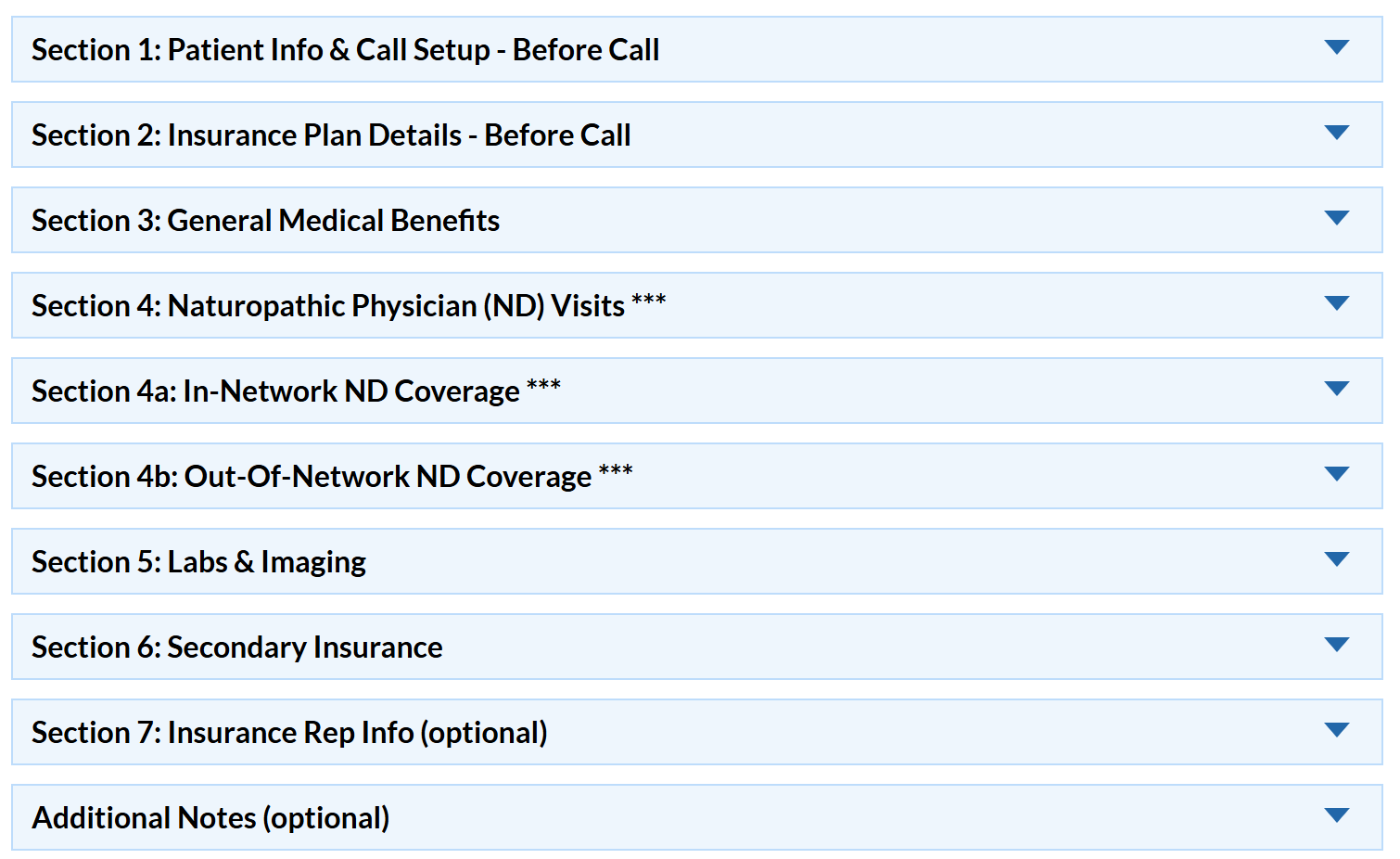
Most sections of the worksheet are collapsible when completed within Charm as a questionnaire. (See screenshot of sections below.)
You can expand sections as you need them and hide sections you’re not using. If forms tend to feel overwhelming, this can help reduce visual clutter and make the form feel more manageable.
[Note: Collapsing a section will not erase your responses.]
Before You Call:
Gather your insurance card(s).
If available, log in to your insurance app or member portal, as it may contain information that isn't on your insurance card.
If possible, use a computer instead of your phone to complete the worksheet in Charm. That way, you can easily fill out the worksheet while you're on the phone with the insurance company. If you don’t have access to a computer or a second device, let me know and we'll figure out an alternative.
Sections to complete before calling:
These sections can be completed using information from your insurance card or insurance member portal/app.
Section 1: Patient Info & Call Setup
Includes the phone number you’ll be calling, which should be on the back of your insurance card (often “Customer Service” or “Member Services”).
Section 2: Insurance Plan Details - insurance plan name, ID number, group number, plan type, etc.
Section 3: General Medical Benefits - You may be able to fill in some of this section using your insurance card or portal, but plan to confirm it with the insurance rep so you can correct it if needed.
This section is about your general medical benefits, NOT naturopathic medicine-specific coverage.
e.g. deductible info, out of pocket max, primary care vs specialist costs, both in-network and OON.
Section 6: Secondary Insurance - This section asks if you have more than one insurance plan and requires that you select “yes” or “no.”
When you have more than one health insurance plan, one is your primary insurance and the other is your secondary insurance. Both insurers need to know about each other so claims can be processed correctly, and to help prevent delays, denials, and unexpected bills.
If you have a secondary insurance plan, fill out this section before you call.
Other Preparation Tips:
Skim the form in its entirety to get oriented to the form and what you’ll be asking about.
Set an intention for the call: to allow yourself to pause, ask questions, or request clarification as needed. (You're not expected to be an insurance expert.)
During the Call:
General Tips:
Use the worksheet to guide the conversation and record the rep’s answers in the fields provided.
If a question or field doesn’t apply to you or your plan, write “N/A” rather than leaving it blank, when possible.
Include “$” or “%” when entering copay or coinsurance amounts.
Fields marked with a red asterisk (*) are required.
Sections to Complete or Review During the Call:
Section 3: General Medical Benefits- Verify your general medical benefits
e.g. deductible info, out of pocket max, primary care vs specialist visit costs, both in-network and OON.
Also confirm your annual reset date, i.e. when your deductibles and out-of-pockets maximums reset each year.
Section 4: Naturopathic Physician (ND) Visits - Ask if your specific insurance plan covers office visits with NDs.
If ND visits are covered, you’ll skip ahead to Section 4a or 4b, based on my current network status with your insurance plan.
To confirm if I am in-network with your specific insurance plan, you can provide the insurance rep with the NPI(s) below:
Dr. Heidi Wilson - Individual/Rendering (Type 1) NPI: 1730430612.
If needed: Organization/ Billing (Type 2) NPI for Curio Integrative Mental Health LLC: 1295691244.
If ND visits are NOT covered or the insurance rep is unsure, please fill out the remaining questions in Section 4 and then skip ahead to Section 5.
If the representative says ND visits aren't covered, ask them to look up Dr. Wilson using her NPI number(s) (listed above). This can help if they're unfamiliar with naturopathic physicians (NDs) or aren't sure how to check your plan's coverage for ND visits.
In Section 4a and/or 4b, you’ll ask the rep about the copay ($) or coinsurance (%) amount per ND visit, if you need to meet your deductible before they’ll pay anything, visit limits, prior authorization, and if telehealth visits are covered.
Section 4a: In-Network ND Coverage - Complete this section if I am in-network with your insurance plan
Section 4b: Out-Of-Network ND Coverage - Complete this section if I am NOT in network with your insurance plan.
You only need to complete the section that matches Dr. Wilson's current network status. However, if you'd like both in-network and OON coverage information for future reference, you're welcome to complete both sections, but this is optional.
Don’t forget to ask about telehealth visit coverage, including if there are any limitations.
Note: If the insurance rep says ND office visits are covered the same way as Specialist office visits, you may be able to use the information from Section 3 for some of the ND coverage details in Sections 4a or 4b. However, it's still a good idea to double-check each item with the insurance rep.
Section 5: Labs & Imaging- Ask if labs and imaging are covered when ordered by an ND and which lab/imaging centers are considered in-network.
Labs and imaging are billed separately from office visits. Coverage and cost often depend on where the test is done (the lab facility, e.g. Quest, Labcorp) and what test is ordered.
Insurance reps may not be able to give precise cost estimates, as out-of-pocket costs can vary significantly by test, diagnosis, and facility, and are commonly subject to deductible and/or coinsurance.
Section 6: Secondary Insurance- If you have more than one insurance plan, confirm that your insurance company has your secondary insurance on file for Coordination of Benefits (COB). In the worksheet, scroll down to STEP 2 within Section 6 for questions to ask.
Insurance companies use a process called Coordination of Benefits (COB) to decide which plan pays first and how much each pays. Both insurers need to know about each other so claims can be processed correctly, and to help prevent delays, denials, and unexpected bills.
If they don’t have your secondary insurance on file, give them that plan information (which you’ll hopefully already have recorded in that section).
If they need you to complete a COB form or require anything else, be sure to write down what they need or any next steps. There is space on the worksheet for such notes.
Section 7: Insurance Rep Info (optional) - record the insurance representative’s name and the call/reference ID.
Writing down the rep’s name and call/reference ID can be helpful if you need to follow up later or if there’s any confusion about what you were told.
NOTE: Because you're completing the worksheet/form as a questionnaire in Charm, it doesn't automatically save your progress.
- Don't close the questionnaire before clicking "Submit," or your responses will be lost.
- Don't click "Submit" until you've finished the worksheet and reviewed your responses. Once submitted, you won't be able to make changes.
After submitting the form, you will be able to view or download it at any time in your Charm portal, under Questionnaires or Patient Documents.